
Customer area
Access your account or request distributor registration.
Key factors to consider when choosing your ideal enclosure
Comparte esta noticia
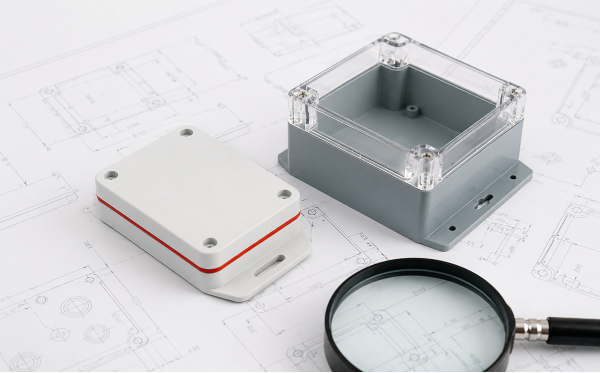
Choosing the right enclosure for an electronic project is not always as simple as it may seem. Size, PCB layout, application environment, material, protection rating, and even the appearance of the final product can all influence the decision.
Taking the time to analyze these factors during the early design stage can help avoid redesigns, reduce costs, and make it easier to find a more efficient, practical, and durable solution for your assembly.
1) Start with the PCB: size, layout, and fixing points
One of the first aspects to consider when looking for the ideal enclosure is the potential size and layout of the PCB. Whenever possible, the best approach is to design the board with a few standard enclosures in mind.
This flexible design approach allows you to take better advantage of the enclosure’s internal features, such as integrated PCB supports, fixing bosses, or wiring areas. Adapting the board to fit the enclosure helps make full use of the internal space and simplifies assembly.
Planning the PCB layout and mounting points during the design phase also makes it easier to position connectors, cable entries, pushbuttons, displays, or any other external elements.
If the PCB design is completed before an enclosure has been selected, it may be difficult to find a housing that fits properly. This could mean choosing a larger product than necessary or even redesigning the board.
2) Analyze the application environment
The environment where the product will be installed is key when selecting the right enclosure. Designing equipment for an office is not the same as designing for an industrial installation, an outdoor environment, or an application exposed to impacts, moisture, or sunlight.
Before choosing the enclosure, consider these questions:
- Will the product be exposed to moisture or dust?
- Will it receive direct sunlight for long periods?
- Is there a risk of shocks, vibration, or impact?
- Will it be installed indoors, outdoors, or inside a machine?
- Will maintenance or frequent access to the inside be required?
Answering these questions helps define the most suitable protection rating, material, and design.
3) Protection rating: IP against dust, water, and external agents
Electronic components must be protected against the ingress of external agents such as dust particles, liquids, tools, or even accidental human contact.
That is why it is important to analyze the real exposure of the product and check the IP rating before specifying an enclosure. The IP rating indicates the level of protection against solids and liquids and helps select the right housing to keep the electronics safe.
For indoor applications, a basic level of protection may be sufficient, while industrial, outdoor, or humid environments may require a higher protection rating.
Choosing the right IP protection helps prevent condensation, corrosion, short circuits, and premature field failures.
4) Materials: resistance, temperature, and durability
Every material has its own advantages and limitations. Choosing the right material is therefore essential to ensure a long service life and effective protection for the electronic components.
If the equipment will operate in low- or high-temperature environments, it is important to check the material specifications provided by the manufacturer. These indicate the thermal range the enclosure can withstand and help avoid deformation, brittleness, or loss of mechanical properties.
Materials such as steel or die-cast aluminum are commonly used when superior mechanical strength is required. Plastic materials such as ABS or polycarbonate, on the other hand, offer a lightweight, versatile solution suitable for a wide range of electronic applications.
5) Impact resistance: IK rating
When there is a risk of impacts, vibration, or physical manipulation, it is also important to assess the enclosure’s impact resistance. This level of protection is indicated by the IK rating.
Checking the IK rating and material specifications helps select a more suitable enclosure for industrial applications, publicly accessible equipment, machinery, or installations where accidental impacts may occur.
6) Electromagnetic and radio-frequency interference
Radio-frequency and electromagnetic interference generated by other devices can also influence material selection.
If the product’s operation may be affected by external interference, it may be necessary to choose a solution that helps block it. Metal enclosures generally provide higher protection against this type of interference without additional modifications.
Plastic enclosures naturally provide less electromagnetic protection. However, they can incorporate specific internal coatings to improve this performance. In this case, the additional cost should be considered when comparing plastic and metal solutions.
7) UV stability for outdoor projects
In outdoor applications, prolonged exposure to ultraviolet radiation can cause discoloration or degradation in some plastic materials.
If the enclosure will be installed outdoors, it is therefore important to analyze the UV stability of the material. Polycarbonate generally offers good resistance to UV degradation. ABS can also be used if a UV stabilizer is added during the manufacturing process.
This information should always be checked with the enclosure manufacturer to ensure the material is suitable for the intended environment.
8) Appearance: when the enclosure is part of the product
The appearance of the enclosure can be a decisive factor, especially when the product will be visible to the end user.
In hidden technical installations or inside machinery, aesthetics may be secondary. However, in publicly visible equipment, control devices, user interfaces, or commercial products, the enclosure’s appearance directly influences how the product is perceived.
For this reason, it is advisable to identify enclosures that match the desired aesthetics before finalizing the board design. This avoids later compromises and helps achieve a more coherent solution between electronics, functionality, and design.
9) Custom enclosures: when a standard solution is not enough
In some cases, it may not be possible to adapt the PCB to an existing standard enclosure. In these situations, a custom solution may need to be considered.
Designing and manufacturing a custom enclosure provides maximum flexibility, but it also requires careful analysis of the same factors: protection against dust and water, materials, mechanical resistance, application environment, accessibility, appearance, and mounting system.
At Supertronic, we can help you find the best solution, whether through a standard enclosure, a custom enclosure, or the modification of an existing housing using our CNC machining, UV digital printing, and other customization services.
Final practical tips
- Design the PCB with possible standard enclosures in mind from the beginning.
- Always check the real internal space, not only the external dimensions.
- Analyze the application environment before choosing the material and IP protection.
- Consider temperature, impacts, humidity, sunlight exposure, and interference.
- Pay attention to appearance if the product will be visible to the end user.
- Consider a custom enclosure if no standard solution fits properly.
Choosing the ideal enclosure from the early stage of the project helps reduce costs, avoid redesigns, and improve the reliability of the final product.
For more information on how to specify your ideal enclosure, call us at +34 932 980 257 or write to info@supertronic.com.