
Customer area
Access your account or request distributor registration.
Quick Guide to Potting Boxes: Design and Applications
Comparte esta noticia
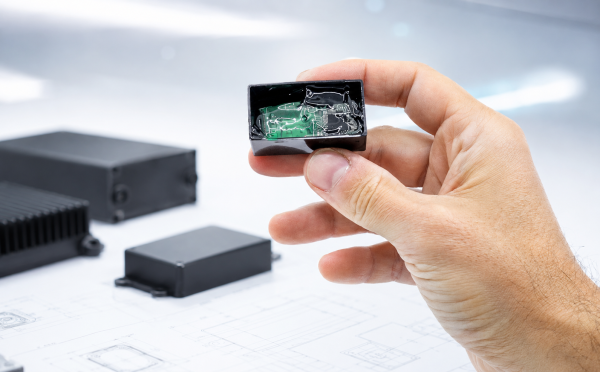
When designing an electronic device, circuit protection is just as important as performance. In many projects, simply placing the PCB inside an enclosure is not enough: it also needs to be protected against humidity, dust, vibrations, impacts, temperature changes, and even unauthorized manipulation.
In these cases, potting boxes are a highly effective solution. These are enclosures designed to house a PCB or electronic component and then be filled with resin, gel, or another potting compound. The result is a more robust, sealed module, ready to work in demanding environments.
1) What are potting boxes in electronics?
Potting boxes are plastic enclosures designed to protect electronic circuits by filling the inside with a protective compound. This process, known as electronic potting, allows sensitive components on a board to be fully or partially covered.
Unlike a conventional enclosure, where the circuit remains accessible inside, in a potting box the filling material surrounds the electronics and protects them from external agents.
This type of solution is especially useful when the equipment must operate for long periods of time, with little maintenance, and in conditions where reliability is critical.
2) Why use a potting box?
Potting transforms a fragile electronic circuit into a more compact, protected, and stable assembly. Its main advantages include:
- Protection against humidity and dust: helps prevent corrosion, condensation, and possible electrical short circuits.
- Resistance to impacts and vibrations: keeps components stable during use.
- Greater protection against tampering: makes direct access to the circuit and reverse engineering more difficult.
- Additional mechanical protection: reduces the risk of damage during transport, installation, or operation.
- Improved thermal management: some potting compounds can help dissipate the heat generated by the device.
In short, a potting box is not only used to house electronics, but also to extend their service life and reduce field failures.
3) Common potting materials
The enclosure itself is usually made of plastic, while the inside is filled with a specific compound depending on the application. The most common materials are:
Epoxy resin
Epoxy resin provides very strong and durable protection. It offers excellent adhesion and creates a rigid encapsulation, ideal when a permanent and highly robust solution is required.
It is a good choice for applications where the circuit is not expected to be repaired or modified after potting.
Polyurethane
Polyurethane is more flexible than epoxy resin and absorbs vibrations or small movements more effectively. It can be a good alternative when the device will be exposed to impacts, vibrations, or expansion.
It can also help reduce stress on certain electronic components.
Silicone
Silicone stands out for its thermal resistance and greater flexibility. In some cases, it also makes maintenance or repair easier compared to more rigid compounds.
It is especially interesting in applications with temperature changes or components that are sensitive to mechanical stress.
4) Design factors before potting a PCB
Before choosing the box and potting compound, several technical aspects should be considered. A good decision during the design phase can help avoid costly problems later.
1) Does the circuit generate heat?
If the device generates heat during operation, it is important to assess how that heat will be dissipated once the circuit is potted. In these cases, it may be necessary to use compounds with thermally conductive properties or design the enclosure with heat evacuation in mind.
2) Will there be temperature changes?
Materials expand and contract with thermal changes. If the enclosure, PCB, and potting compound are not compatible, stress may be generated on the components.
That is why it is important to choose a material suited to the working environment.
3) Will you need to access the circuit afterwards?
Potting is usually a permanent or difficult-to-remove solution. If you need to carry out testing, maintenance, or diagnostics, this should be planned before filling the box.
A good practice is to include test points, accessible connectors, or non-potted areas where necessary.
4) How much volume do you need to fill?
The internal volume of the box determines the amount of resin or gel required. In addition, some materials may shrink during curing, so it is important to calculate the filling volume correctly and choose a suitable geometry.
5) What level of protection do you need?
Not all projects require the same level of protection. Potting a small indoor sensor is not the same as protecting a device exposed to humidity, outdoor conditions, vibration, or industrial use.
The box should be selected according to the real application environment.
5) Common applications of potting boxes
Potting boxes are used in many sectors where electronics must remain protected and stable over long periods of time.
Some common applications include:
- Sensors and control units for the automotive sector.
- Power supplies, transformers, and electronic modules.
- Electronics for outdoor, humid, or marine environments.
- Equipment installed in industrial machinery.
- Control, measurement, and automation systems.
- Devices where circuit tampering must be prevented.
In all these cases, potting helps improve the reliability of the final product and reduces the risk of failures caused by external agents.
6) How to choose the right potting box
Although they may seem like simple housings, potting boxes play a key role in the performance and durability of the device. To choose correctly, it is important to review:
- The PCB size and maximum component height.
- The internal volume required for the potting compound.
- The position of cables, connectors, or outputs.
- The usage environment: humidity, dust, vibrations, temperature, or outdoor exposure.
- Compatibility between the box, potting compound, and electronics.
- The need for machining, cable entries, or customization.
Choosing correctly from the beginning helps avoid redesigns, improves protection, and simplifies assembly.
7) Customization: boxes ready for your electronics
At Supertronic, we can help you adapt the box to the real needs of your project. Thanks to our customization services, it is possible to prepare the enclosure before assembly through:
- CNC machining for cable outputs, connectors, windows, or special housings.
- UV digital printing for logos, technical texts, or product identification.
The goal is for you to receive a practical, customized box that is ready to integrate with your components.
Final practical tips
- Do not choose the box only by its external dimensions: always check the real internal space.
- Define from the beginning whether the potting will be total or partial.
- Take working temperature and thermal dissipation into account.
- Plan test points or accessible connectors before potting.
- Choose the filling compound according to the environment: rigidity, flexibility, temperature, vibration, and maintenance needs.
Potting boxes are a simple but highly effective solution for protecting electronic circuits in demanding applications. If you are developing a new project, at Supertronic we can help you choose the most suitable box and adapt it to your electronics, making assembly faster, safer, and more reliable.