
Customer area
Access your account or request distributor registration.
What comes first: designing the PCB or choosing the enclosure for your electronic device?
Comparte esta noticia
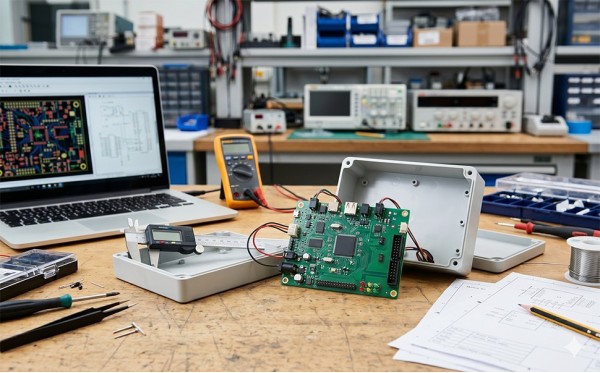
When developing an electronic device, one of the most important decisions comes earlier than it may seem: deciding whether to design the PCB first or to select the enclosure that will house it beforehand.
This choice can directly influence costs, development times, ease of assembly, product aesthetics and industrial feasibility. At Supertronic, we regularly work with engineers, product designers and electronic device manufacturers, and we know that good planning from the beginning can prevent many problems in later stages.
DESIGNING THE PCB FIRST
In many projects, the starting point is the printed circuit board. The technical team first focuses on the electronic architecture, component placement, connectivity, signal management and overall performance of the device.
This approach is common in developments where electronics play a critical role or when working from an existing PCB.
Advantages of designing the PCB first
- Greater freedom to optimise the electronic design.
- Possibility to prioritise performance, connectivity and component placement.
- Easier reuse of existing PCB designs across different projects.
- Suitable approach when the enclosure will be fully customised.
Disadvantages of designing the PCB first
- Risk that the board may not fit properly into a standard enclosure.
- Possible space, fixing or assembly issues.
- Need to adapt the enclosure later or resort to a custom-made solution.
- Higher risk of extra costs if mechanical design is considered too late.
When does it make sense to design the PCB first?
Designing the PCB first can be a good option when the project requires high electronic performance, when component placement is especially critical or when a fully customised enclosure is already planned.
In these cases, Supertronic can help you find a standard enclosure that fits the board or, if the project requires large quantities, develop a custom enclosure through the design and manufacture of a plastic injection mould.
CHOOSING THE ENCLOSURE FIRST
Another strategy is to select the device enclosure first, defining from the beginning the external dimensions, mounting system, internal fixing points, connector positions and protection requirements.
From there, the PCB is designed to fit correctly inside the available space within the enclosure.
Advantages of choosing the enclosure first
- Makes it easier to use a standard enclosure, reducing costs and lead times.
- Helps define the final size of the product from the beginning.
- Reduces mechanical integration risks.
- Simplifies assembly, PCB fixing and connector positioning.
- Allows requirements such as resistance, ergonomics or IP protection rating to be considered from the start.
Disadvantages of choosing the enclosure first
- Less flexibility in PCB design.
- Possible limitations in component placement.
- Need to adapt the electronic design to the available space.
- May require more coordination between the electronic and mechanical teams.
When is it advisable to choose the enclosure first?
Choosing the enclosure first is especially recommended for IoT devices, control equipment, industrial products, portable devices, consumer products or any application where size, aesthetics, resistance, ergonomics or assembly play an important role.
It is also a very interesting option when the goal is to use a standard enclosure to optimise costs and reduce development time.
The best option: designing the PCB and the enclosure in parallel
Although both approaches are valid, the best practice is usually to work on the electronic and mechanical design in parallel from the earliest stages of the project.
This makes it possible to jointly define key aspects such as:
- PCB dimensions.
- Position of connectors, push buttons, displays or LED indicators.
- Internal fixing points.
- Ventilation or heat dissipation requirements.
- Space for wiring, batteries or accessories.
- Machining, printing or personalisation requirements.
- Required level of protection, resistance or sealing.
Working in parallel helps reduce errors, avoid redesigns and speed up the product’s time to market.
How can Supertronic help?
At Supertronic, we offer a wide range of standard plastic enclosures for electronics, as well as customisation services to adapt each enclosure to the specific needs of your project.
We can help you whether you already have a designed PCB or are still in the early stages of development and need to define the most suitable enclosure.
Our services include:
- Advice on selecting standard enclosures.
- CNC machining for connectors, push buttons, displays, ventilation openings, etc.
- UV digital printing for logos, technical markings and visual personalisation, etc.
- Manufacture of adhesive front panels and membrane keypads.
- Design and manufacture of plastic injection moulds for custom enclosures.
The goal is clear: to ensure that the electronics and the enclosure fit perfectly, both technically and aesthetically.
Conclusion
There is no single valid answer for every project. In some cases, it will be better to design the PCB first; in others, it will be more efficient to select the enclosure first. However, whenever possible, the most advisable approach is to work on both elements in parallel from the beginning.
Good coordination between electronic and mechanical design can save time, reduce costs and improve the final result of the product.
At Supertronic, we can support you throughout the entire process to find, customise or manufacture the most suitable enclosure for your electronic device.